Free Course

AI-Branding Magazine

AI & SEO: SEO Isn’t Dead, It’s Fragmenting
At a market level, the “collapse” narrative doesn’t hold up. A Graphite analysis based on Similarweb estimates across 40,000+ major U.S. sites reported year-over-year organic search traffic down about 2.5%, and the very largest sites still grew slightly — pointing to uneven impact, not an existential drop.
In the same dataset, overall search engine traffic in 2025 was up about +0.4%, and Google traffic was up about +0.8% — reinforcing that demand hasn’t collapsed, even as clicks fragment. Those can both be true: search activity can hold or grow while organic visits soften, because more intent gets satisfied directly on the SERP.
Graphite compared Similarweb-estimated organic search traffic across 40,000+ major U.S. sites in two windows (Feb–Dec 2024 vs Jan–Nov 2025). Similarweb’s estimates model visits using a mix of opt-in panels, ISP/mobile data, public web signals, and direct measurement from participating sites; Graphite also validated trends against first-party Google Search Console / Google Analytics across multiple sites and reported a median correlation of 0.86.
Impact is not evenly distributed: the top 10 sites grew organic traffic by ~1.6%, while declines were concentrated among mid-sized publishers ranked roughly #100–#10,000. That pressure also skews toward informational queries, where AI Overviews and SERP features reduce the available “clickable attention,” while commercial/transactional terms tend to be less affected.
Paid isn’t “stealing” organic at scale: the share of clicks going to ads rose by about two percentage points, but the mix remained roughly ~90% organic vs ~10% ads, with organic still generating about 10× more clicks than paid placements.
Note: zero-click is the share of searches with no click; the ~90/10 split refers to the distribution among clicks that do happen.
(Source: https://searchengineland.com/organic-search-traffic-down-yoy-data-467748)
How to apply this (experience/trust angle, without hype):
A practical way to use these insights is to segment reporting by brand vs non-brand and informational vs commercial intent, then prioritize topic clusters and proof assets where informational clicks are most compressed.
Why “SEO is dead” is the new “email is dead”
The “SEO is dead” storyline tends to appear whenever the interface changes. We’ve seen the same pattern with email over the years: people declare it “dead,” yet it remains one of the most effective channels when it’s executed with relevance, trust, and strong fundamentals.
Search is in a similar moment. AI isn’t wiping out search demand — it’s changing how answers are presented and how often users need to click. That distinction matters. The rational response isn’t panic; it’s adapting strategy to a more competitive, more fragmented results page while doubling down on what compounds: topical coverage, proof, and brand demand.
What’s actually changing in the SERP: attention and clicks fragment
What’s “new” isn’t that people stopped searching — it’s that the SERP absorbs more intent on-page.
- AI Overviews can reduce click-through when they appear. A large-scale Graphite analysis, summarized by Search Engine Land, found AI Overviews were associated with roughly ~–35% CTR impact when present, and appeared in ~30% of SERPs, skewing informational queries.
(Source: https://searchengineland.com/organic-search-traffic-down-yoy-data-467748) - More SERP features split attention. Featured snippets, People Also Ask, video blocks, forums/community modules, local packs, and other rich results create more “decision points” before a classic blue-link click happens.
- Zero-click is a structural reality. SparkToro’s 2024 study estimated that 58.5% (US) and 59.7% (EU) Google searches ended with no click.
(Source: https://sparktoro.com/blog/2024-zero-click-search-study-for-every-1000-us-google-searches-only-374-clicks-go-to-the-open-web-in-the-eu-its-360/)
Net effect: “easy info” content faces more click compression, while decision-stage needs (comparison, selection, evaluation) often still drive clicks — especially when the page offers something that can’t be fully satisfied in a short on-SERP answer.
AI visibility answer block
SEO isn’t dead — informational clicks are getting harder. AI answers and SERP features satisfy simple questions faster, so the remaining clicks increasingly go to content that proves expertise, covers the full intent spectrum, and provides first-party evidence (data, tests, visuals, real examples).
Same and everything: what changes in SEO with AI (the new layers)
The fundamentals still matter: technical health, content quality, crawlability, links, and measurement. What AI adds is a new layer: how demand gets distributed and what earns the click.
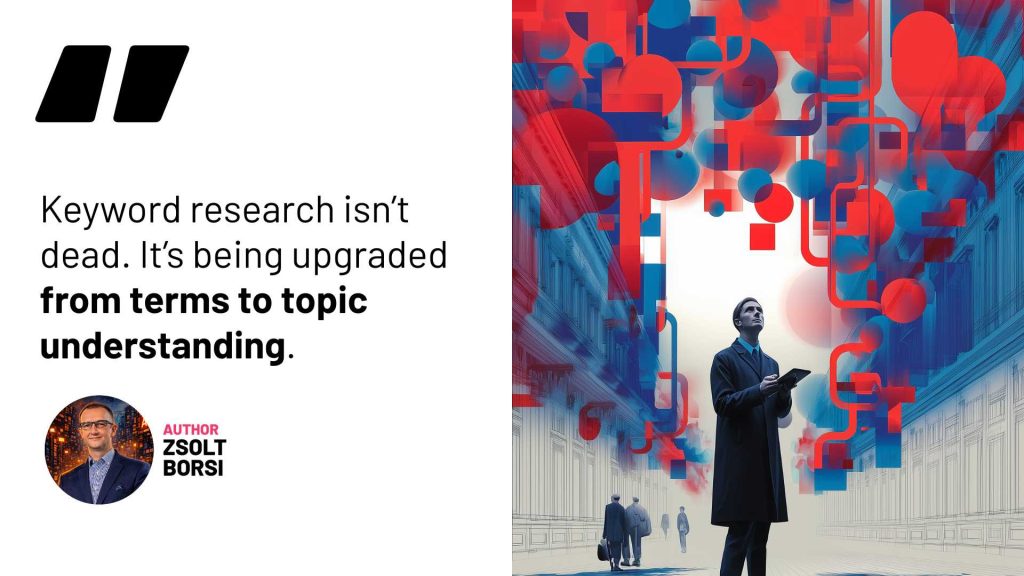
From keywords to entities (and intent sets)
Keyword lists are a starting point — but entity-led SEO reflects how modern systems connect meaning.
Instead of optimizing for one phrase at a time, build coverage around an entity and its surrounding intent set:
- definitions and core attributes
- use cases and constraints
- comparisons and alternatives
- decision criteria and “best for” scenarios
- FAQs rooted in real objections
This doesn’t replace keyword research — it upgrades it from “terms” to topic understanding.
Topic clustering: pillar + clusters + internal linking as an evidence network
If one approach compounds in an AI-shaped SERP, it’s topic clustering — and it’s a core principle in the AI Branding Academy. Build topic clusters that cover a subject end-to-end: a strong pillar page as the canonical hub, supported by focused cluster pieces that answer the full set of related questions and intents, connected through smart internal linking. This structure helps Google (and AI systems) understand your topical depth and consistency, strengthening your relevance signals and making it more likely your content gets surfaced or cited when AI-generated answers are shown.
Think in Content series, not standalone posts. A Content series is a topic-led set of pages that covers the full scope of a subject — including the key entities, keywords, phrases, and real user questions connected to that topic — organized as a pillar page plus supporting cluster pieces and tied together with intentional internal linking.
- Pillar page: the canonical “source of truth” for the topic
- Cluster pages: focused articles that answer specific sub-intents (and can rank independently)
- Internal linking: connects the system, distributes authority, and makes topical depth legible
This structure helps both users and machines recognize comprehensive topical coverage and consistent expertise — not just a single-query play.
Brand building: why it matters more now
As informational clicks get squeezed, brand demand becomes a stabilizer. Strong brands win more navigational searches, more repeat visits, and often better click share when multiple SERP elements compete for attention.
Brand mentions can also function as contextual signals across the broader web ecosystem. Not as a “hack,” and not a guarantee — but as part of how trust and relevance accumulate over time.
What to do now: a practical 90-day reset plan
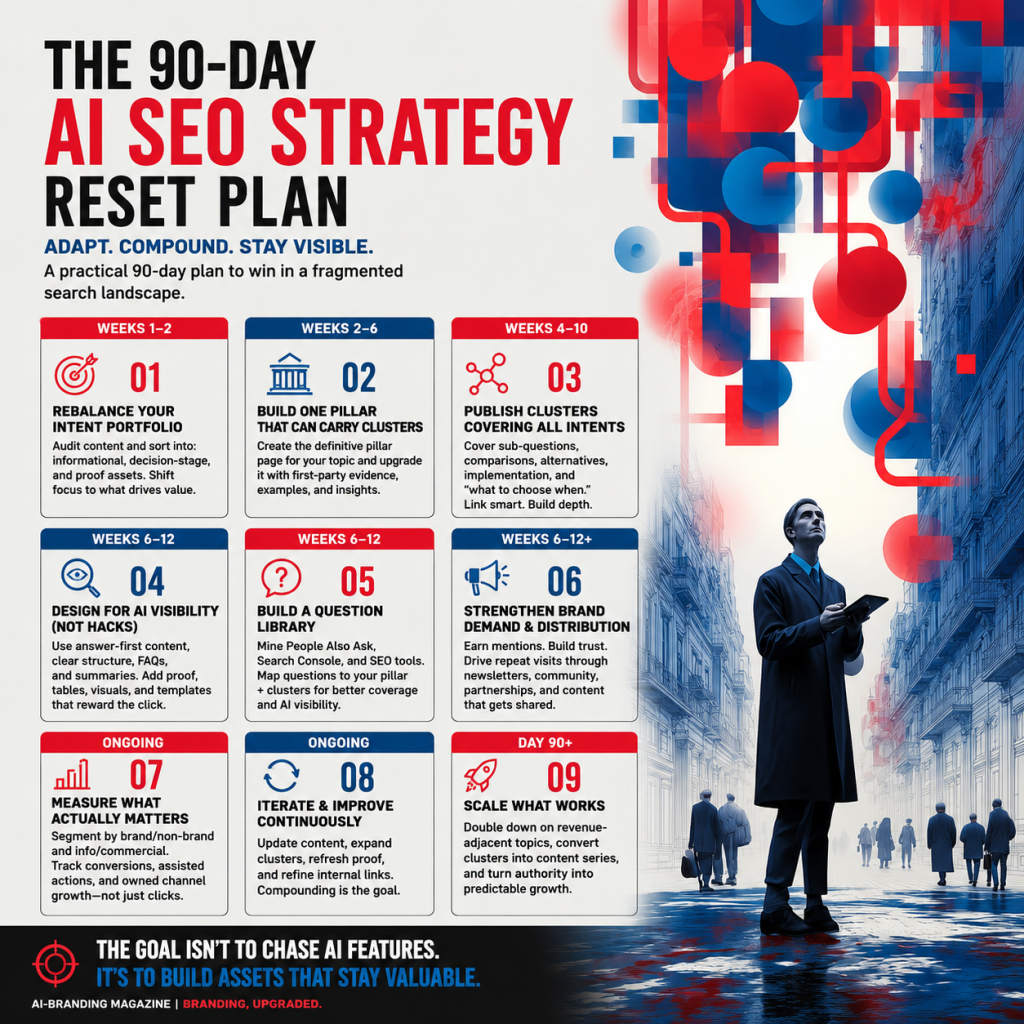
This is where “AI and SEO” becomes operational.
CEO / Founder / CMO: align on a 90-day reset (intent portfolio + 1 pillar + clusters), reset KPIs from sessions to business value, and invest in at least one proof asset (original data, tests, visuals).
In-house SEO / Content lead: map the entity + intent set, build the pillar–cluster plan with deliberate internal linking, and upgrade priority pages with answer-first structure plus first-party evidence.
Agency owner: productize topic clustering (pillar + clusters + internal links), report by segments (brand/non-brand, info/commercial), and ship proof-driven assets clients can’t get from generic AI summaries.
The goal isn’t to chase AI features; it’s to build assets that stay valuable even when informational clicks compress.
Weeks 1–2: rebalance your intent portfolio (before you publish anything new).
Start by sorting your existing content into three buckets: (1) easy informational pages that can be answered in a few sentences, (2) decision-stage pages that help someone choose (comparisons, alternatives, “best for,” pricing logic, trade-offs), and (3) proof assets (original data, tests, visuals, templates). The quickest resilience win is usually reducing reliance on bucket #1 while expanding #2 and #3.
Weeks 2–6: build one “pillar” that can carry clusters (and upgrade it with evidence).
Pick one topic where you can credibly be the best reference. Treat it as an entity-led pillar: clear definition, scope, decision criteria, common pitfalls, and a short “best next step” section. Then add proof: screenshots, mini benchmarks, first-hand workflow notes, or original examples. The point is simple: publish what can’t be fully satisfied by a short on-SERP summary.
Weeks 4–10: publish clusters that cover the full intent spectrum.
Don’t just expand breadth; expand usefulness. Clusters should cover informational sub-questions and decision-stage intents: comparisons, alternatives, implementation paths, and “what to choose when…” scenarios. Each cluster should link back to the pillar (and to sibling clusters where it genuinely helps). This is how topic clustering compounds: it creates a navigable system, not isolated posts.
Weeks 6–12: design for AI visibility without chasing hacks.
Use a clean structure that makes extraction easy and reading enjoyable: short “answer-first” paragraphs, descriptive headings, and a brief summary where it adds clarity. When AI Overviews are present, the click incentive often shifts from “get an answer” to “get proof, nuance, and a confident decision.” Build for that: show your work, define edge cases, and include artifacts (tables, visuals, checklists, templates) that reward the visit.
AI answers often follow a question–answer format, so write for that: turn more headings into questions, and treat your FAQ / knowledge base as a core asset. It won’t guarantee inclusion in AI answers, but it can improve the odds of being surfaced or cited because it mirrors how people search—and how systems extract concise responses. Build the question set around your key entities using People Also Ask, Search Console queries, and tools like Semrush, then map those questions to your pillar + cluster pages.
Ongoing: strengthen brand demand and distribution.
As informational clicks fragment, brand becomes a stabilizer: people search for you by name, trust your POV, and return directly. That doesn’t mean “branding replaces SEO.” It means SEO performs better when it’s paired with repeatable distribution loops (newsletter, community, partnerships, earned mentions). Brand mentions can also matter as contextual signals across the web ecosystem — not as a shortcut, but as a byproduct of genuine visibility and trust.
How to measure success when clicks get harder
If stakeholders expect “sessions up and to the right,” AI-era SERPs will create friction — especially for easy informational content. A more useful measurement model is:
- Segment first, then judge. Separate brand vs. non-brand, informational vs. commercial, and (where possible) queries that tend to trigger rich results/AI answers vs. those that don’t. A blended KPI hides the story.
- Track value, not just visits. For decision-stage content, conversions and assisted conversions matter more than CTR. For informational content, measure whether it moves people into owned channels (newsletter signups, trials, demo requests, tools usage).
- Report outcomes with context. A lower CTR can be rational if impressions rise, qualified actions increase, or the content set shifts toward revenue-adjacent intent.
The practical stakeholder line is: organic search demand hasn’t disappeared, but the click layer is more competitive and more fragmented, so success should be evaluated closer to business value.
Closing: SEO isn’t dead — it’s evolving into a higher standard
AI raises the bar on what deserves a click. Thin definitions and generic how-tos will be increasingly hard to sustain. The durable advantage is still familiar: understand the topic better than competitors, organize it better (entity-led clustering), prove it better (first-party evidence), and earn preference (brand demand).
It changes — but it doesn’t disappear.
FAQ
Is SEO still worth investing in if AI Overviews reduce CTR?
Yes — but the investment mix changes. The priority shifts toward decision-stage content and proof assets that create a reason to click, even when informational answers are available on the SERP.
Which content types are most at risk of losing clicks?
Content that can be summarized in a few sentences (basic definitions, overly generic how-tos, “what is X” pages with no original insight) tends to face the most click compression.
What does “entity-first SEO” look like in practice?
It means building coverage around a concept and its real-world intent set — attributes, use cases, constraints, comparisons, and decision criteria — rather than treating each keyword as an isolated target.
How do you optimize for AI visibility without chasing gimmicks?
Use clean structure: clear headings, short answer-first passages, concise summaries, and explicit definitions. Then add what AI can’t compress well: evidence, examples, visuals, and original testing.
Is topic clustering only for big sites with huge content teams?
No. It’s often more valuable for smaller teams because it prevents random publishing. One strong pillar plus a focused cluster set can outperform dozens of disconnected posts.
Do brand mentions matter for AI-era search?
Yes — and the role of brand is getting bigger. As clicks fragment and AI answers absorb more informational intent, brand becomes a differentiator: it increases trust, drives navigational demand, and can influence which sources are considered credible in the broader ecosystem. Brand mentions are part of that trust fabric — not a standalone lever you can “pull,” and not a guarantee, but a signal that tends to grow alongside authority. The practical move is to earn mentions through consistent usefulness: first-party proof, a clear point of view, and distribution that puts your work in front of the right audiences.

AUTHOR: Zsolt Borsi
Zsolt Borsi helps e-commerce businesses break free from Google Ads dependency. Builds data-driven SEO systems that turn paid traffic costs into organic revenue. AI Branding Partner. Systems, not magic.
Upcoming AI-Branding Academy Workshop


